This is not a presence pot and not a master volume. It only changes how much of the output-transformer secondary is fed back into the phase-inverter tail. The 1971 Deluxe Reverb restoration on this site already carries this switch.
What this mod does
The stock AB763 Deluxe Reverb takes NFB from the 8 Ω tap through 820 Ω into the PI tail. The unused ON–OFF–ON ground switch becomes:
| Throw | Name | Loop |
|---|---|---|
| One end | Silver | 820 Ω — stock |
| Center | Tweed | Open — no NFB |
| Other end | Blonde | 820 Ω + 820 Ω = 1.64 k |
Tremolo, reverb, and both preamp channels stay stock. Only global feedback changes.
Who it is for
- Silverface (or blackface) AB763-family amps with a spare ON–OFF–ON ground / polarity switch
- A reversible voicing switch with no extra hole
- Players who want stock tightness, a looser mid voice, and an open tweed-style loop on one toggle
It is not for amps that still need that switch as an AC polarity switch on a two-prong cord. Convert the power cord to three-wire earth first. It is not for amps that already use that hole for something else.
How the stock loop is arranged
AB763 Deluxe Reverb:
Output transformer 8 Ω tap → 820 Ω NFB resistor → PI tail (junction with the 47 Ω NFB tail / 22 k PI tail network)
More feedback (smaller resistor) = tighter, cleaner, less touch. Less feedback (larger resistor or open) = looser, more gain at the speaker, earlier breakup. This switch only changes that one resistor path.
Parts
| Item | Value | Notes |
|---|---|---|
| Added NFB resistor | 820 Ω, ½ W | Between the two outer switch lugs |
| Stock NFB resistor | 820 Ω | Stays in the amp |
| Switch | Factory ON–OFF–ON SPDT | Center off = Tweed |
| Death cap | .047 / 500 VAC or similar | Remove it |
| Safety earth | Three-wire cord, chassis bonded | Do not lift |
No extra pot. No extra hole.
Exact connection points
Lift one end of the stock 820 Ω NFB resistor so the loop is no longer a permanent wire from OT tap to PI tail.
Stock 820 Ω — one end stays on the OT 8 Ω tap (or on the PI tail — pick one side and stay consistent). The free end goes to one outer lug of the switch.
New 820 Ω — soldered between the two outer lugs. Nothing else lands on that resistor.
Switch common — the remaining end of the loop: PI tail if the stock 820 is on the OT tap; OT 8 Ω tap if the stock 820 is on the PI tail.
Center — no connection. That is Tweed.
Death cap — remove it. The switch is no longer in the mains.
Safety ground — chassis stays bonded to mains earth. This switch is not a ground lift.
- Silver: common to the lug that already has the stock 820 → 820 Ω. The extra 820 hangs on the unused lug and is out of circuit.
- Blonde: common to the other outer lug → current must pass the new 820 then the stock 820 → 1.64 k.
- Tweed: common open.
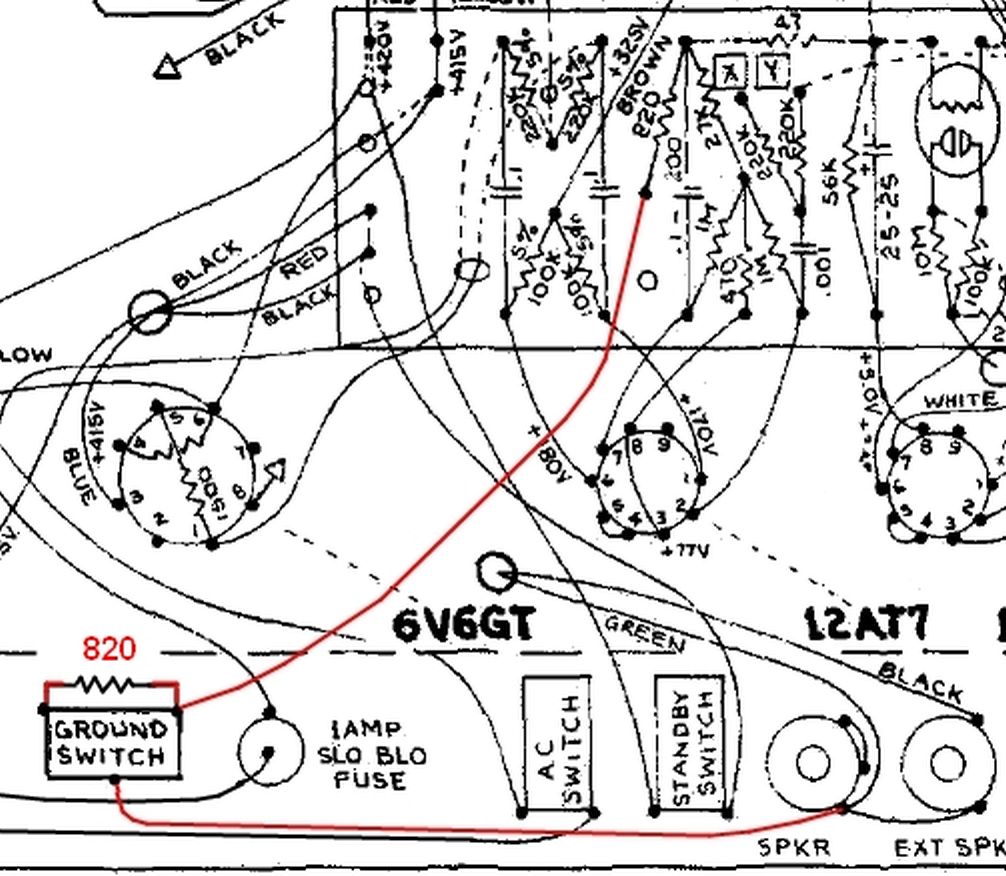
Step-by-step
- Photograph the switch, death cap, and NFB resistor.
- Unplug the amp. Wait. Discharge the filter caps with a proper resistor bleed. Confirm every B+ node with a meter.
- Confirm the switch is ON–OFF–ON SPDT and that it is the spare ground / polarity switch.
- Confirm the amp has a three-wire earth and the chassis is bonded.
- Remove the death cap.
- Identify the stock 820 Ω from the 8 Ω tap to the PI tail.
- Lift one end of that 820 Ω.
- Run that free end to one outer lug.
- Solder the new 820 Ω between the two outer lugs.
- Run the switch common to the open side of the loop (PI tail or OT tap).
- Check throws with a meter, amp off: Silver continuity through 820 Ω, Blonde through ~1.64 k, center open.
- Dress leads away from the PI grid wires.
- Power up on a limiter.
- Listen Silver / Blonde / Tweed at modest volume first. Confirm no squeal on Tweed with Treble and Reverb up. Stock grid stoppers hold this loop on a Deluxe Reverb.
On PCB reissues the pads are often single-sided and fragile. Use a temperature-controlled iron and do not linger on a pad.
What you will hear
- Silver — stock AB763: firm low end, controlled breakup.
- Blonde — less loop: more touch, earlier grind, a little more bloom.
- Tweed — no loop: loudest feel, loosest low end, most speaker interaction. Stoppers keep it stable on this chassis.
The Reverb and Tremolo knobs do not change function. Both channels hear the same power-amp voice because NFB is global.
Why this switch and not a pot
The factory ground / polarity switch is leftover two-prong thinking. Once the amp has a proper three-wire earth, that toggle is spare. Three fixed loops beat a presence pot you have to explain every time someone sits down.
NFB lives after both preamps, at the PI tail. Silver, Blonde, and Tweed therefore hit Normal and Vibrato the same way. That is the topology of this mod, not a side effect.
Pros
- One unused factory switch
- One added resistor
- Fully reversible: put the stock 820 back and the amp is stock
- Death cap leaves the amp
- Three useful voices, not a sweep pot
- No extra hole in a vintage faceplate
Cons
- Tweed can bark on a bright speaker or a noisy PI tube
- Global — you cannot put Tweed on Normal and Silver on Vibrato
- Wrong OT tap (4 Ω vs 8 Ω vs 16 Ω) changes the math; this guide is the Deluxe 8 Ω / 820 Ω loop
- If the switch was still doing polarity duty on a two-prong cord, this mod is not the first job
Compatibility
Good candidates — Deluxe Reverb AB763 / silverface with 820 Ω NFB and a spare ground switch. Same idea on Super, Twin, Pro, and Vibrolux if you keep their stock NFB resistor as Silver and series an identical resistor for Blonde.
Needs extra care — ’65 reissues and other single-sided PCB amps. Export wiring that still uses that switch. Amps with a presence network already in the tail.
Not this switch — two-prong amps that still rely on a polarity switch. Fit earth first. Amps that already filled that hole with another mod.
Optional follow-ons
These are not required for the switch to work.
- Label the three throws Silver / Blonde / Tweed on the chassis lip so the next tech does not treat center as “off.”
- If Tweed is too wild on a given speaker, leave the center unused and run only Silver / Blonde.
Troubleshooting
| Symptom | Likely cause |
|---|---|
| No difference between throws | Common not in the loop, or stock 820 never lifted |
| Blonde same as Silver | New 820 not between the outer lugs, or a shorted lug |
| Tweed same as Silver | Center position is not open — wrong switch |
| Squeal on Tweed | Lead dress at the PI, bad stoppers, or a microphonic PI tube |
| Hum after the job | Death cap removed but a mains lead left hanging; or earth lifted |
| Thin / weak on all throws | NFB taken from the wrong OT tap |
Correct wiring gives three different loops. Check with a meter first, amp off: Silver ~820 Ω, Blonde ~1.64 k, center open, measured from the 8 Ω tap to the PI tail node.
Bottom line
One new 820 Ω between the outer lugs of the factory ON–OFF–ON ground switch. Stock 820 to one outer lug, common closes the loop. Silver = 820 Ω, Blonde = 1.64 k, Tweed = open. Death cap out. Earth stays. Remove the added resistor and put the stock 820 back, and the amp is stock again.