Stock Fender two-channel reverb amps send only the Vibrato channel into the tank. The Normal channel goes from its second preamp stage straight to the phase inverter. This mod bleeds a high-pass slice of that Normal signal onto the reverb-driver grid. It is not the Fritz, Torres, 68 Custom plate-jump, or RobRobinette mixer-resistor conversion. Those dump the whole Normal path into the Vibrato mixer and extra gain stage. This one does not.
What this mod does
One small capacitor:
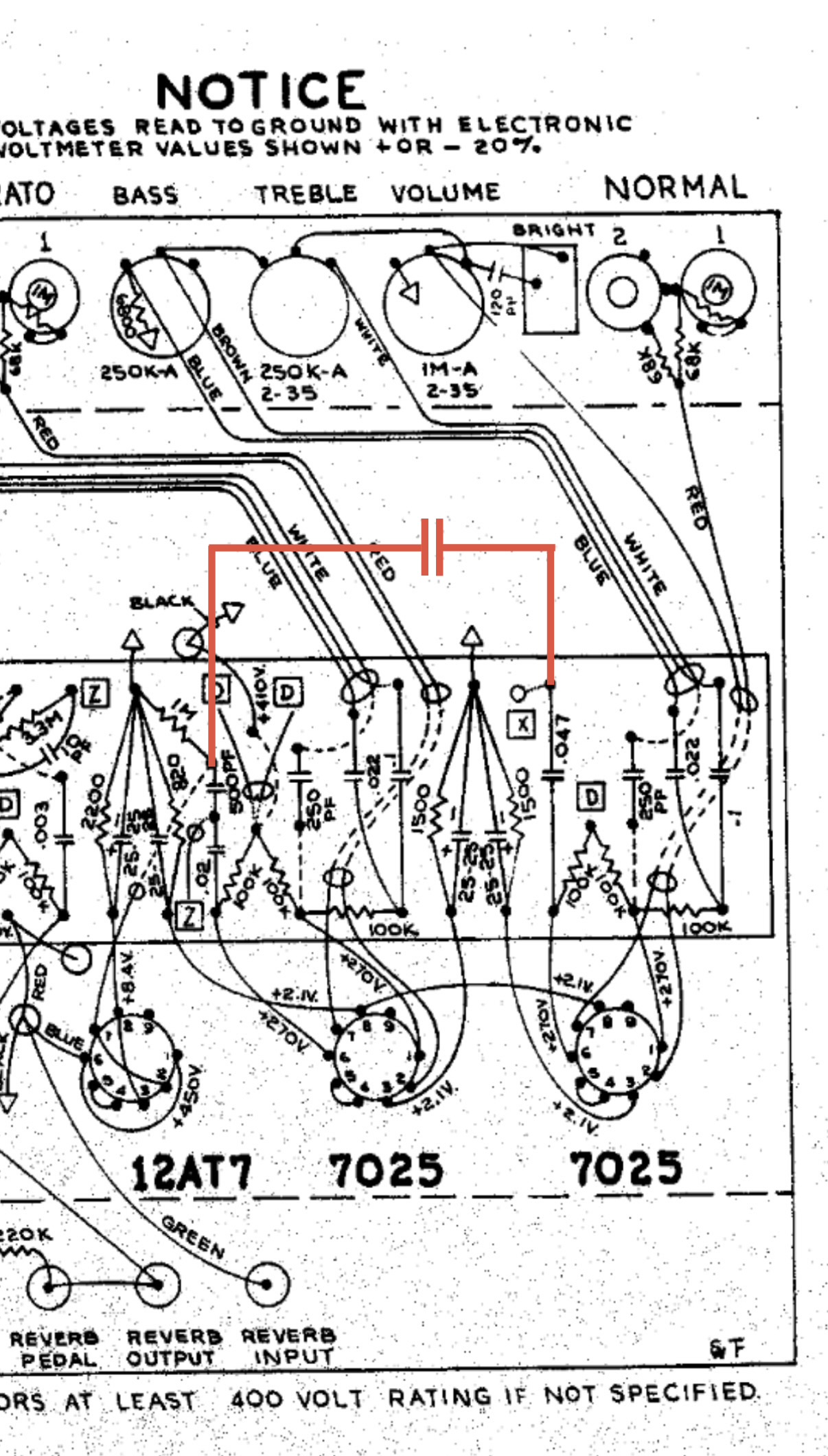
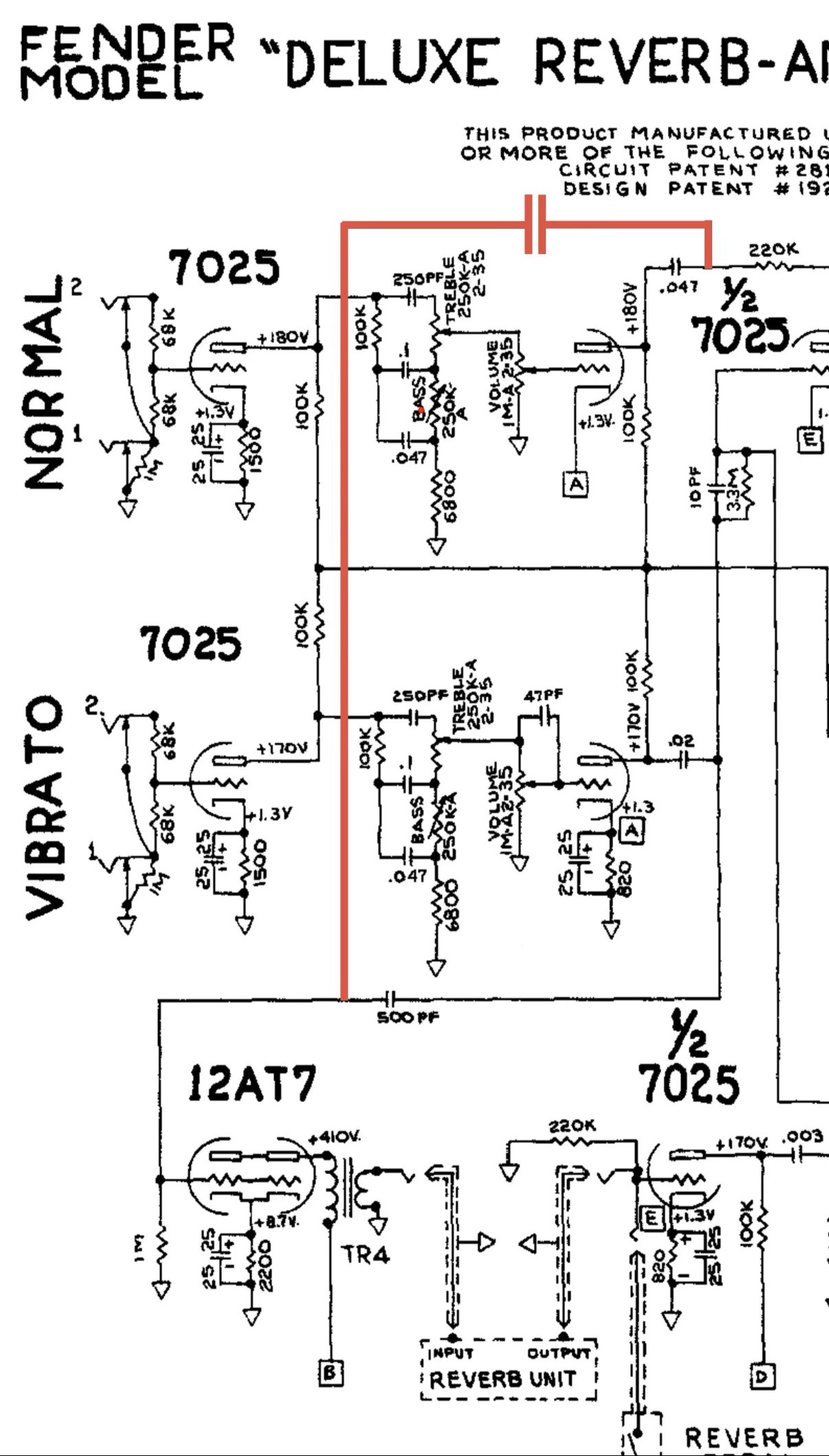
- From the Normal channel output — after the .047 µF coupling cap, at the 220 k mixer junction
- To the grid of the reverb-driver 12AT7 (V3)
The front-panel Reverb knob still sets wet level for the tank. After the tap, the tank is driven by both channels, so that same knob also sets reverb on Normal.
Tremolo is not part of this mod. Tremolo sits later on the Vibrato path only. The tap does not route Normal into that circuit.
Who it is for
- Players who use the Normal channel and want spring on it
- A change that stays tiny and fully reversible
- Keeping the Normal channel’s slightly fuller dry tone instead of forcing it through the Vibrato extra stage and .022 µF coupling cap
- Vintage eyelet boards and PCB reissues (reissues need extra care with pads)
It is not for single-channel amps (Princeton Reverb, Champ, and the like) or amps that never had a reverb tank and driver.
How the stock circuit is arranged
Typical AB763 signal flow:
Normal
Input → V1A → tone stack / volume → V1B → .047 µF coupling cap → 220 k mixer resistor → phase inverter
Vibrato
Input → V2A → tone stack / volume (often with bright cap) → V2B → .022 µF coupling cap → split:
- dry path through the mixer into V4B (third gain stage) → tremolo → phase inverter
- wet path through the ~500 pF filter → V3 grid (reverb driver) → tank → recovery → mix
The tap copies a filtered version of the Normal signal onto that same V3 grid node. That is why reverb appears on Normal and tremolo does not.
Parts
| Item | Typical value | Notes |
|---|---|---|
| Tap capacitor | 330 pF silver mica | Standard starting value |
| Alternate values | 250 pF, 300 pF, 470 pF | See cap-value table below |
| Voltage rating | 500 V or higher | This node is not B+; extra rating is fine |
| Dielectric | Silver mica | Polystyrene also works |
| Lead dress | Short leads, cap close to the board | Prevents hum pickup |
No extra pots, resistors, or switches are required.
Exact connection points
Source (Normal channel) — the junction of:
- the output side of the Normal .047 µF coupling cap
- the 220 k mixer resistor that feeds the phase inverter
Do not tap before the .047 µF cap. That puts DC on the new cap and changes the plate load.
Destination (reverb driver) — the grid of V3 (12AT7 reverb driver). On a stock AB763 this node already has the stock ~500 pF reverb-filter cap from the Vibrato send.
Keep leads short and dress the cap against the board so it does not become an antenna.
Cap value
The tap cap is a high-pass into the driver grid. Smaller cap = less low end into the tank.
| Value | Character on Normal |
|---|---|
| 250 pF | Tighter, brighter reverb, less tank rumble |
| 300–330 pF | Standard starting point |
| 470 pF | Fuller wet signal, closer to stock Vibrato reverb |
Start at 330 pF. Swap the cap if the wet sound is too thin or too dark.
Step-by-step
- Photograph the board and any leads you may disturb.
- Unplug the amp. Wait. Discharge the filter caps with a proper resistor bleed. Confirm every B+ node with a meter.
- Identify the two nodes on your amp with the schematic in hand.
- Solder one end of the 330 pF cap to the Normal .047 µF / 220 k junction.
- Solder the other end to the V3 grid node. Keep the cap body close to the board.
- Check for bridges and stray whiskers.
- Test: guitar in Normal, Reverb up. You should hear spring on Normal.
- Vibrato channel reverb should still work as before.
- Tremolo Intensity and Speed should still affect only the Vibrato channel.
- If Normal reverb is too weak or too dark, change the cap value.
- Secure the cap so it cannot vibrate against other parts.
On PCB reissues the pads are often single-sided and fragile. Use a temperature-controlled iron and do not linger on a pad.
What you will hear
- Normal dry tone stays close to stock: same coupling cap, same mixer path to the PI, no extra gain stage.
- Reverb appears on Normal. Depth is set by the existing Reverb knob.
- Reverb on Normal is a bit brighter and less dense than Vibrato reverb, because the tap is a small high-pass cap rather than the full Vibrato send network.
- There is one Reverb knob for both channels. There is no independent wet/dry for Normal unless you add more parts later.
- Tremolo stays on the Vibrato channel.
- Channel interaction stays low. The Normal dry path is unchanged.
- Phase is unchanged. Jumpering the two inputs still behaves as it did stock.
Why reverb moves and tremolo does not
The Reverb control does not sit on the Normal channel. It sits in the send/recovery loop driven by V3. The tap adds a second source onto that same V3 grid, so the tank — and the one Reverb knob — now include Normal.
Tremolo lives downstream of the reverb mixer, on the Vibrato path only:
Vibrato → V2B → mix with tank return → V4B → tremolo → phase inverter
Normal still goes:
Normal → V1B → .047 µF → 220 k mixer → phase inverter
Dry Normal never enters the tremolo circuit. That is the topology of this mod, not a side effect.
If you want tremolo on Normal as well, stop here and use a mixer-style conversion (Fritz, RobRobinette, or 68 Custom plate jump) instead of stacking extra wiring onto this tap.
Pros
- Smallest parts count of any internal reverb-on-Normal mod
- Fully reversible: remove the cap and the amp is stock
- Dry Normal tone is preserved
- Vibrato channel circuit is left alone
- Low interaction between channels
- Works on vintage boards and many reissues
- Easy to voice with one cap swap
- No extra mixing resistors and no extra attenuation from those resistors
Cons
- Reverb on Normal is a tap, not a full send. Wet level can be lower or thinner than on Vibrato unless you enlarge the cap.
- One Reverb knob for both channels.
- Tremolo does not move to the Normal channel.
- Extra drive into the tank at high Reverb settings with both channels running can make spring crash more likely.
- Long leads on the tap cap pick up hum.
- On PCB reissues, a sloppy solder job can lift a pad.
- This is not a “two identical channels with effects” conversion.
Compatibility
Good candidates — Deluxe Reverb, Super Reverb, Twin Reverb, Pro Reverb, Vibrolux Reverb, Vibroverb (AB763 family), and silverface equivalents that still have a separate Normal .047 µF coupling cap and a 12AT7 reverb driver.
Needs extra care — ’65 Deluxe Reverb Reissue and other single-sided PCB amps. Same electrical idea; weaker pads.
Not this mod — Princeton Reverb and other one-channel amps. Circuits without this reverb topology. Amps that already jumper plates or mix both channels into the tank.
68 Custom Deluxe Reverb — Fender already mixed both channels into the effects another way. Confirm the board before adding a tap.
Optional follow-ons
These are not required for the tap to work.
- Swap V3 from 12AT7 to 12AU7 if the tank is too hot and the Reverb knob is unusable below 2–3. That change affects both channels.
- Add a switch in series with the tap cap if you want to defeat Normal reverb without removing the cap.
Troubleshooting
| Symptom | Likely cause |
|---|---|
| No reverb on Normal | Wrong node, open cap, or dead Normal preamp |
| Reverb on Normal is tiny | Cap too small; try 470 pF |
| Reverb on Normal is boomy | Cap too large; try 250–300 pF |
| New hum | Long leads on the tap cap |
| Squeal at high Reverb | Tank overdriven from two sources; lower Reverb or drop tap value |
| Vibrato reverb changed a lot | Wrong destination node or a short at V3 grid |
| Normal quieter or thin | .047 µF cap or 220 k mixer disturbed |
| Tremolo on Normal dry signal | Wrong connection point — the tap is not on V3 grid only |
Correct nodes give reverb on Normal and leave tremolo on Vibrato. Check: guitar in Normal only, Vibrato volume at zero, Reverb up, then Intensity/Speed. Dry Normal should not throb. If it does, the cap is not on the two nodes this guide specifies.
Bottom line
One 330 pF silver mica from the Normal coupling-cap output to the reverb-driver grid. Normal keeps its dry voice, gains spring reverb, and the Reverb knob sets wet level for both channels. Tremolo stays on the Vibrato channel because that circuit is downstream of the tap and not on the Normal path. Remove the cap and the amp is stock again.